Spring in the Garden

Spring in the Garden

Friday, 20 April 2012

Ideas for Encouraging Wildlife in Your Garden

The reason I garden organically is because I don't want to damage the natural environment or the creatures that inhabit it. Gardening organically isn't just about not using nasty chemicals, it's about improving the soil and the growing conditions as much as possible and using alternatives to pesticides, fungicides and herbicides. It's also about using approved fertilisers wisely and sparingly.

A dunnock exploring our garden

As we are hearing more and more, looking after the local wildlife requires more than just refraining from using chemicals that kill, or may weaken, bees, butterflies and other beneficial insects as well as birds and other animals.

An article in the Guardian yesterday reminded us that the shrinking number of hedgerows in the countryside mean that the gardener has an important role to play in helping provide habitats for hedgehogs.  If you can't provide a mixed native hedge a pile of logs and leaves will provide hedgehogs with shelter.  A log pile is also good for all manner of insects, which may in turn encourage a wide range of birds into your garden. Leaving patches of longer grass is also good for insects.

Cowslips and primroses add a splash of colour to the garden early in the year

If you are still thinking about what flowers to plant why not try a patch of wild flowers, either grown from seed or by buying a few from your local garden centre. If you don't want wild flowers,  try to avoid too many showy double flowers which are not designed for bees and butterflies to reach the nectar and may not even have the pollen bees need to rear their young.  Instead experiment with some cottage garden favourites such as foxgloves, snapdragons and penstemons.

Honey bee on cherry blossom on a very warm day in March
Most herbs provide nectar rich flowers, including the lavenders, as do fruit trees, bushes and plants such as strawberries. Simple roses, especially those with a scent attract bees and butterflies.  Sarah Raven suggests a number of single dahlias amongst other flowers that are good for bees and butterflies.

An early bumblebee foraging in Winter heather in March
If possible try to plan your garden so there are flowers to provide nectar and pollen from early Spring into late Autumn.  Bees and butterflies don't fly when it's very cold and flowers need warmth and moisture in order to make nectar. Pulmonaria, often known as lungwort or 'soldiers and sailors' is a good plant for the early spring as are early Spring bulbs such as snowdrops, crocus and some members of the narcissus family.  Winter heathers are good early in the year while the late heathers provide nectar into September and beyond.

The Bumblebee Conservation Trust provide a list of seasonal plants while Butterfly Conservation offers further suggestions.  The RHS provides a pretty comprehensive list of plants for pollinators here

I've just come across The Pollinator Garden, a great website which has a wealth of information about gardening for wildlife.


Tuesday, 17 April 2012

Our Next Venture

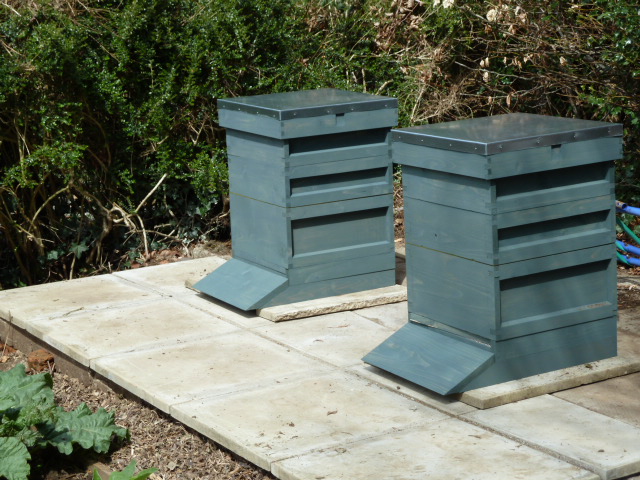
We have two new additions to our garden.


If you've been paying close attention to the layout of our garden you may be thinking that we used to have some perfectly good compost bins there, and you would be right.

We still have the compost bins.  Hubby has transformed this overgrown corner of the garden from this 

to this

You'll notice that the compost bins are to the right of the two (dead) cherry trees, which look like they are at the edge of the garden in the top picture. In case you don't recognise them they are both covered in ivy in the top picture and only one is in the lower picture.

The two constructions at the top of the page are not fancy compost bins, they are real National beehives, which hubby has just finished making and painting. We got seconds kits to make the beehives.  This means there was the occasional knot in the wood, but that doesn't matter much where the hives are concerned. It could be more of a problem when making the frames.   Hubby extended the paved area where the compost bins were to make a bigger level platform for us to stand on when working with the bees.  He's been very busy in the garden this last month or so.

We don't have any bees yet, but we have just finished a ten week theory course in beekeeping for beginners and are about to embark on a ten week practical course.  We hope we'll be ready to take charge of a colony of bees by early to mid summer.  So watch this space.

Bees and beekeeping is a fascinating, if sometimes complicated, subject.  We are taking our course at Blackhorse Apiaries, but if that isn't near you check out your local Beekeeping Association for locally held courses.  You may have missed the beginners' course for now as they tend to be held early and late in the year.

Monday, 16 April 2012

Fudge and Smokie Say 'Hello'

After some thought we decided to call our new chickens Smokie and Fudge.

Smokie is a Bluebelle type hybrid, which means she is a cross between a Rhode Island Red and a Cuckoo Maran. We are told that this is very placid and docile breed, but when Amber tries to show her she's boss, Smokie fights back.

Smokie saying 'hello' to Amber. She didn't seem aggressive.


Fudge is a Black Rock type hybrid, although not an officially bred Black Rock. She is a cross between a Rhode Island Red and a Plymouth Barr Rock. She is very small at the moment even though she is meant to be the same age as Smokie. The Black Rock type chickens are meant to be hardy birds bred for their good eggshell quality. Fudge seems to know she's no match for the bigger birds and is very submissive so far. When the sun shines on her black feathers they are iridescent.

Fudge is wondering if she likes cabbage.
   

A Sad Day, Ending on a Positive Note

RIP Bella
We're not very lucky with our chickens at the moment.  On Thursday evening, just as we were sitting down to dinner, we noticed a dark stain on Bella's rear end, then Amber started pecking at her.  So dinner was interrupted as we went out into the garden to separate them and see what was wrong with Bella.  As we feared, and guessed, the dark stain was blood.  I didn't take too close a look, but hubby and daughter both said there was a bit of a protrusion.  Luckily I'd had a delivery of gardening supplies in a box that was just the right size for a chicken so, after lining it with newspaper and straw we put Bella in it.  We recalled that we had seen her earlier sitting down slightly oddly, but only very slightly oddly.  We hadn't thought that could mean there was anything wrong.  You only learn that sort of thing with hindsight.

Friday morning hubby rang the vet bright and early and took Bella to see her.  It was not such a bad prolapse as Anna had had, but with Bella being a young chicken who laid eggs nearly every day, every time she laid an egg it would all come out again however many times we popped it back in again, and there would be times when we couldn't pop it back very soon as we would be at work.  So we felt we had no real choice other than to have Bella put down.  As we had had two young chickens with the same problem within a month the vet wanted to do an autopsy to check there was no underlying cause, but she found nothing obvious. Vent pecking was also ruled out as Amber did not have a bloody face.   The vet also said we should ring John Pile, the breeder, to let him know that both the Light Sussex chickens we'd bought from him in early February had had prolapses as it could be a genetic fault.

We are also wondering what we might have done wrong, but can't think of anything.  Lack of calcium can be sometimes be a cause of prolapse, but they had plenty of oyster grit.  We don't think we treated them any differently than our first three chickens. 

Obviously we were a bit sad to have lost our beautiful chicken.  Bella and Amber seemed to get on well by then, too.


We have been told that chickens don't like being alone and hubby felt he had a bit of time to spare on Friday, as our ten day Easter break was drawing to a close, so we decided to get two new chickens the same day. We went to a more local breeder called Golden Valley Poultry, who seem to have a good reputation and also rear their chickens organically and let them free range.


We chose from these 22 week old pullets and came home with a Black Rock and a Bluebelle. We decided to go for two different breeds this time to reduce the risk of both having a genetic defect. 


We quickly learnt that they needed to be kept separate as Amber climbed onto the top of the run we had them in and started to try to attack them, making the end of her comb bleed.  As it was fairly sunny we thought it would be OK to let Amber have a run round and get to know the new chooks while they were safe in the run.  We were clearly wrong.

Amber was very interested in the new arrivals
Anna and Bella were much more docile.  We did keep them separate the first day, but they all slept together the first night and came down together in the morning.  Amber was a bit aggressive and they spent the next  two days upstairs, but she didn't really attack either of them.  Then I thought to put in an extra feeder and the three of them played chase between feeders to some extent, but Amber started to tolerate them more.  Anna and Bella never fought back.

Obviously we are hoping that we will have these new chickens for a few years.

Thursday, 12 April 2012

Progress in the Veg Patch

So, it's been a few weeks since I've posted. I've been busy in the garden when time, weather and my energy levels have allowed. I seem to have been fighting one or two colds recently and I think losing Anna in the manner we did, and so soon, knocked me back a bit.

In the vegetable garden I sowed carrots almost three weeks ago, but there is no sign of germination yet, either because the seed has been washed away or the weather isn't warm enough for them.

I like to dig a trench for carrots filling it in with a mixture of sand and soil with the stones taken out.  In an ideal world I would sieve the soil. I'm growing the carrots next to the garlic in the hope that this will deter the carrot fly.


At the very end of March the Honeoye strawberry plants I had ordered at the end of February arrived so I planted them in the bed I had prepared for them.


I mulched them with Strulch yesterday. They have already put on a few more leaves.  To the right you can see I have planted thymes between the paving stones.


Yesterday I planted a variety of red onion sets called Karmen. The onions should have white flesh with red rings and be attractive in salads. They are in the sandy area to the right of the paving stones.  On the left the garlic is coming along nicely.


The broad beans are coming along nicely, although too much water could make them overly leafy apparently.  Not much I can do about that with the weather we are having at the moment.  Hubby has planted his peas behind the broad beans.


The potatoes have started to sprout and have been covered over.

In between times I've been tidying up the flower beds and planting more nectar rich plants for bees and butterflies.  I'll tell you more about that when I have a bit more time to spare.  I'm hoping to get more done in the garden tomorrow.